
Hildegard von Bingen (1098–1179) was a Benedictine abbess, composer, philosopher, and visionary who spent most of her life in the monasteries of Disibodenberg and Rupertsberg, both on the Rhine near Bingen in the German Rhineland. She was also, by any measure, one of the most remarkable natural scientists of the medieval period — and her contributions to herbal medicine were without parallel among women of her era.
Her bitters formula was not incidental to her work. It was central to it.

Who Was Hildegard von Bingen?
Born in 1098 in Bermersheim vor der Höhe (in what is now the Rhineland-Palatinate), Hildegard was given to the church at age eight as a tithe — a common practice among noble families of the time. She grew up under the mentorship of Jutta von Sponheim at the Benedictine monastery of Disibodenberg, eventually becoming abbess herself in 1136.
In 1150, she founded her own monastery at Rupertsberg, near Bingen am Rhein — and in 1165, a second house at Eibingen, just across the Rhine near Rüdesheim. Eibingen Abbey still stands and is still active today, home to a community of Benedictine sisters who maintain Hildegard’s traditions.
Throughout her life, Hildegard was also a prolific writer. Her mystical works — most famously Scivias — brought her international renown. But her natural science works, Physica and Causae et Curae, represent something equally extraordinary: a systematic, practical medicine rooted in observation, tradition, and the resources of the Rhineland landscape.

Hildegard’s Medical Philosophy
Hildegard’s medicine operated within the humoral framework inherited from classical antiquity — the idea that health depends on the balance of four bodily humors (blood, phlegm, yellow bile, and black bile) and their corresponding qualities (hot, cold, wet, dry). This framework, transmitted through Arabic and Benedictine scholarship, shaped European medicine from Galen through to the Renaissance.
Within this framework, Hildegard developed her own highly personal and empirical approach. Her key concept was viriditas — literally “greenness” — a life force she saw as flowing through all living things, humans and plants alike. Disease, in Hildegard’s view, represented a loss or blockage of viriditas; medicine was the art of restoring it.
Bitter herbs played a specific role in this system. They were warming and drying — capable of dissolving the “cold, wet blockages” Hildegard associated with sluggish digestion, phlegm accumulation, and what she called acedia — a kind of torpor she saw as affecting both body and spirit when the digestive fire ran low.

Hildegard’s Bitters in Physica and Causae et Curae
In Physica (Book I: Plants), Hildegard addresses dozens of bitter herbs by name — including Enzian (gentian), Wermut (wormwood), Schafgarbe (yarrow), and Ingwer (ginger) — providing specific guidance on their preparation and use. In Causae et Curae, she addresses the conditions they treat: poor appetite, gastric heaviness, cold stomach, and the suite of symptoms we would now recognize as functional dyspepsia.
Her prescription was consistent: bitter herbs, taken before or with meals, to “awaken the stomach and prepare it for nourishment.” This is precisely the mechanism that modern gastroenterology calls the cephalic phase of digestion — the secretory response triggered by taste that primes the digestive tract before food arrives.
Hildegard’s Bitters Today
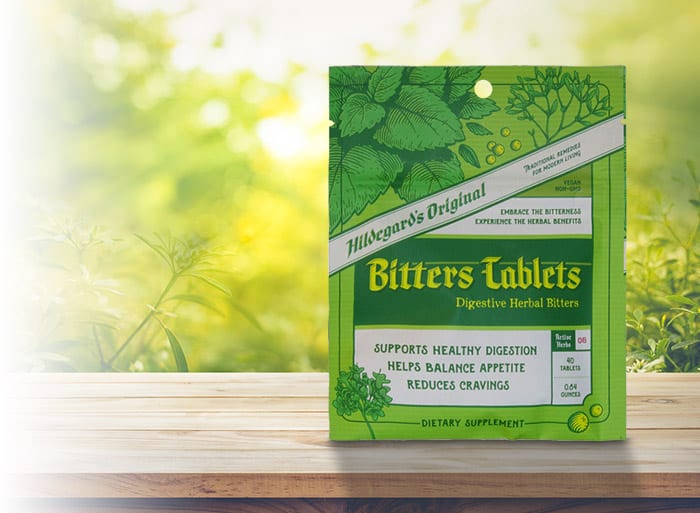
Hildegard’s Original Bitters Tablets are formulated on the foundation of her medieval Rhineland tradition — gentian root (Enzian), ginger (Ingwer), and artichoke, taken before meals as Hildegard intended. No alcohol. Convenient tablet form. Nine centuries of herbal wisdom, distilled.
Central to Hildegard’s bitter formula was gentian root, a plant she described in her Physica as essential to digestive balance. To put her wisdom into daily practice, learn about the tradition of taking bitters before meals — the pre-meal ritual that activates the full benefit of the herbs.
→ Shop Hildegard’s Original Bitters Tablets on Amazon
These statements have not been evaluated by the FDA. This product is not intended to diagnose, treat, cure, or prevent any disease.