
Digestive bitters are herbal extracts made from bitter-tasting plants — roots, barks, and leaves used for centuries to support digestion, stimulate appetite, and calm an overworked gut. Before modern medicine, bitter herbs were the first tool any healer reached for. Across Europe, the tradition of the pre-dinner bitter — the aperitif — existed for exactly this reason: a small dose of concentrated botanical bitterness to prepare the stomach for what was coming.
Today, digestive bitters are experiencing a deserved revival. But for Hildegard von Bingen, the 12th-century German Benedictine abbess, herbalist, and visionary, they were never out of fashion.

Hildegard von Bingen and the Science of Bitters
Hildegard von Bingen (1098–1179) was the most prolific female scientist of the medieval era — a physician, pharmacist, and herbalist whose two major natural science works, Physica and Causae et Curae, documented the medicinal properties of hundreds of plants. Written in the Rhineland monasteries of Disibodenberg and Rupertsberg, her writings drew on centuries of Benedictine monastic medicine and her own clinical observation of patients.
Physica — formally titled Liber Subtilitatum Diversarum Naturarum Creaturarum — dedicates its entire first book to medicinal plants, several of which are the foundational bitter herbs still used in digestive formulas today. Hildegard’s framework centered on discretio — balance and discernment. Bitter herbs played a specific role in her medicine: they were warming and drying, correcting the excess cold and moisture she associated with sluggish digestion and diminished appetite.
In her words (translated from the Latin): bitter plants “warm the stomach and stir what is cold and blocked within.” Modern science confirms that bitter compounds — iridoids and secoiridoids — trigger receptors throughout the digestive tract that stimulate the release of saliva, stomach acid, bile, and digestive enzymes. Hildegard’s 12th-century intuition maps precisely onto 21st-century gastroenterology.
The Three Bitter Herbs at the Heart of Hildegard’s Formula
Gentian Root (Gentiana lutea — Enzian): The king of bitters. Hildegard praised gentian’s power to warm the stomach and counter digestive sluggishness throughout Physica. Its active compound, amarogentin, is among the most potent natural bitter substances known — and among the most effective stimulants of gastric secretion.
Ginger (Zingiber officinale — Ingwer): Hildegard recommended ginger repeatedly across both Physica and Causae et Curae for nausea, bloating, and gastric sluggishness. Over 100 clinical trials have since confirmed its efficacy for nausea, motility disorders, and gastric emptying.
Artichoke (Cynara scolymus): The bitter compound cynarin in artichoke leaf is among the most researched natural bile-stimulating agents. Hildegard identified the artichoke family’s power to support the liver — a connection modern hepatology has fully confirmed.

How Digestive Bitters Work
When you taste something bitter, a cascade of digestive activity begins within seconds. Saliva production increases, beginning carbohydrate breakdown. The stomach releases gastric acid, preparing for protein digestion. The gallbladder contracts, releasing bile to emulsify dietary fat. Pancreatic enzyme secretion increases. Gut motility improves, reducing bloating and the sensation of fullness.
This response — the “cephalic phase” of digestion — is the body preparing itself to do its job properly. Bitter herbs flip the switch. For people whose digestion runs sluggish, who bloat easily after meals, or who notice sugar cravings, this preparation is often exactly what’s missing.
Hildegard’s approach was simple: take bitters before or with meals. Her formula was not medicine for the sick — it was a practice for the well, a way of ensuring the body was primed to extract maximum nourishment from food.
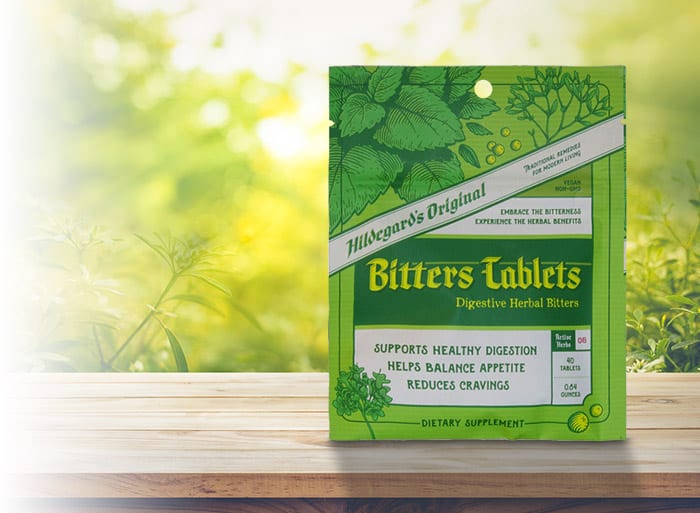
Hildegard’s Original Bitters Tablets
We’ve taken Hildegard von Bingen’s foundational bitter herbs — gentian root, ginger, and artichoke — and put them into a single convenient tablet, taken before meals just as Hildegard intended. No alcohol. No liquid. No aftertaste. Just the concentrated bitter herbal wisdom of a 12th-century German monastery, ready for a 21st-century life.
Explore our guide to the specific herbal digestive bitters Hildegard prized most — including meadowsweet, gentian, and ginger. Or learn more about the time-honored practice of taking bitters before meals and why pre-meal timing amplifies their effect.
→ Shop Hildegard’s Original Bitters Tablets on Amazon
These statements have not been evaluated by the FDA. This product is not intended to diagnose, treat, cure, or prevent any disease.