
Ask a modern herbalist about sage benefits for digestion and you will get a tidy answer about bitter principles and essential oils. Ask Hildegard von Bingen, and you get something stranger and more interesting: a plant that grows, she wrote, more from the warmth of the sun than from the moisture of the earth. For the twelfth-century abbess of Rupertsberg, sage was not a supplement. It was a small piece of evidence that the cosmos is ordered, warm, and on the side of life.
That distinction matters. Hildegard never separated a plant’s usefulness from its place in creation. In her vision, every living thing carries viriditas — the greening power that runs through leaf, blood, and soul alike. Sage, in her reading, is what happens when that greening force is tempered by fire rather than water. Understanding why she thought so tells us more about how to live well than any ingredient list ever could.
What Hildegard Actually Wrote About Sage
Sage appears in the Physica, Hildegard’s book of the natures of created things, under the names selba and salvia. Her opening line is a piece of natural philosophy compressed into a sentence: sage is of a warm and dry nature, and it thrives more through the warmth of the sun than through the moisture of the earth — and for that reason, she says, it is useful against sick humors, because it is dry.
To a reader in 2026 this sounds like poetry. To Hildegard it was mechanics. Medieval physiology understood the body as a shifting balance of four humors, and illness as their excess, deficiency, or corruption. A plant that had absorbed more sun than groundwater was, by that logic, a counterweight to sogginess — to the heavy, cold, damp conditions her contemporaries blamed for sluggishness after meals. If you want the fuller picture of that system, our piece on Hildegard’s bodily humors and the pursuit of balance lays out the framework she was working inside.
Her practical instruction is characteristically plain. Raw or cooked, she writes, sage is good to eat for anyone troubled by harmful humors, because it works against them. She recommends crushing dried sage to a powder and eating it on bread. Elsewhere in the same chapter she describes sage simmered in wine and strained through a cloth, and sage steeped in water and drunk warm. No mysticism, no ceremony — a leaf, a mortar, a piece of bread.
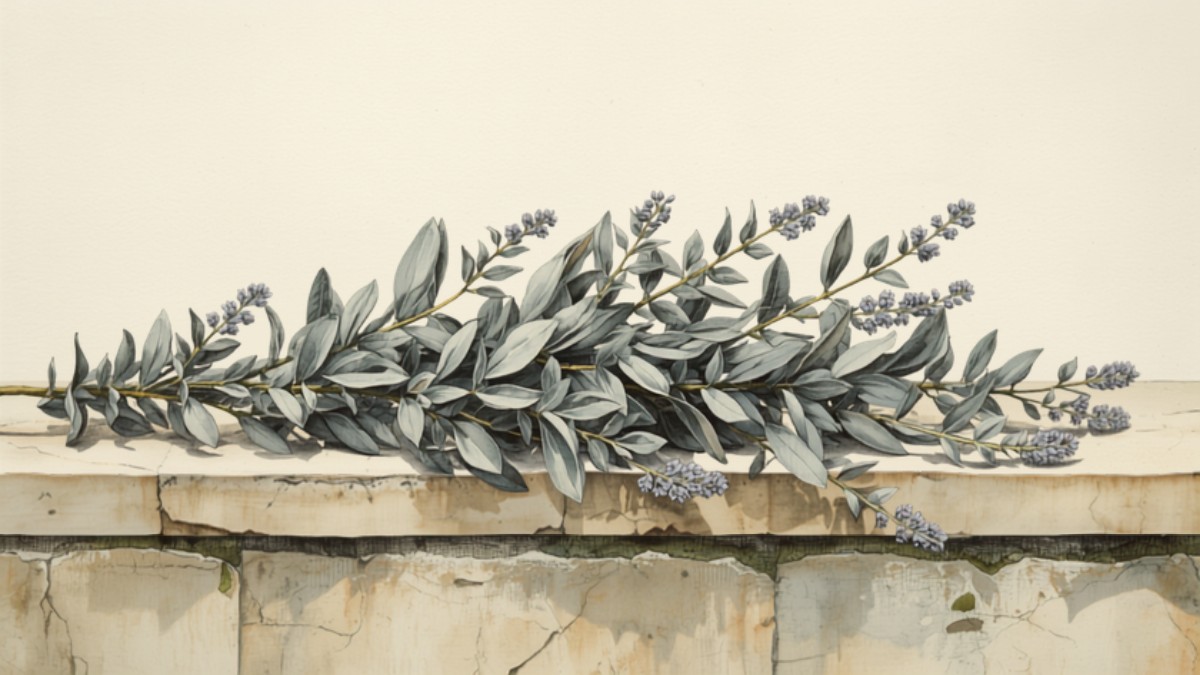
Garden sage (Salvia officinalis), the sun-warmed herb Hildegard described as warm and dry.
Sun, Not Water: Sage and the Logic of Viriditas
Here is where Hildegard’s herbalism stops being a catalogue and becomes a theology. Viriditas — her word for the divine greening that animates creation — is not uniform. Some plants express it as lushness and moisture. Others, like sage, express it as concentration: the same life-force distilled by heat into something dense, aromatic, and durable. A sage bush in a monastery garden in October still holds its leaves when everything soft has collapsed. That persistence was, for Hildegard, a kind of testimony.
Sage had already earned that reputation in the monastic imagination three centuries before her. Walahfrid Strabo, the ninth-century monk of Reichenau, opened his garden poem Hortulus with sage — sweet-smelling, useful to drink, good against many afflictions, and deserving, he wrote, of an ever-greening youth. He added a warning that no marketing copywriter would ever include: left unpruned, sage strangles itself, its new shoots choking the old wood until the parent stem dries out. A plant that must be cut back in order to keep living. It is difficult to imagine a better emblem for what Hildegard meant by balance.
This is why we keep insisting, on this site, that viriditas is not a wellness slogan. It is a claim about how life sustains itself — through greenness, yes, but also through pruning, restraint, and rhythm. The sage bush and the monastic daily routine are making the same argument from different directions.
What Modern Herbal Medicine Says About Sage
Hildegard’s humoral reasoning does not translate into modern pharmacology, and it would be dishonest to pretend otherwise. But her practical conclusion has aged unusually well.
The European Medicines Agency’s Committee on Herbal Medicinal Products maintains a European Union herbal monograph on Salvia officinalis L., folium — sage leaf — adopted in revised form in 2017. Among the traditional uses it recognises is the symptomatic relief of mild dyspeptic complaints such as heartburn and bloating. That designation is not a claim of proven efficacy; under EU rules a traditional-use registration rests on plausibility and a long record of safe use rather than on clinical trials. But it is a formal European regulator acknowledging, in 2017, roughly what a German abbess wrote down in the 1150s.
The phytochemistry is suggestive. Sage leaf contains essential oil, tannins, flavonoids, triterpenes, and — the detail that will interest readers of this site — diterpene bitter principles. That last category is the reason sage belongs in a conversation about bitters at all. Bitter compounds are traditionally understood to work not by supplying something the body lacks but by prompting it: the bitter taste itself is the signal. We have written at length about how digestive bitters are thought to work, and sage sits comfortably in that family alongside its more famous relatives.
Broader pharmacological reviews of Salvia officinalis catalogue antioxidant, antimicrobial, and anti-inflammatory activity in laboratory and animal models, along with a genuinely interesting literature on cognition. Those findings are preliminary and largely preclinical. They are not a reason to take sage for any disease. They are a reason to take seriously the possibility that a plant valued for nine centuries was valued for reasons.

Dried sage, mortar and amber glass: the plain tools of the monastic infirmary.
Discretio: The Reason Sage Asks for Restraint
If viriditas is Hildegard’s most quoted idea, discretio is her most useful one. Borrowed from the Benedictine Rule, it means measure — the practised judgment that knows how much is enough. Hildegard applies it relentlessly: in Causae et Curae she treats both excess and deficiency as forms of disorder, and she is as suspicious of heroic asceticism as she is of indulgence.
Sage is a near-perfect illustration. Its essential oil contains thujone, a compound it shares with wormwood. Thujone is neurotoxic at sufficient dose, and the EMA has set an acceptable daily intake of 5.0 mg per person and limited oral use of sage leaf preparations to a maximum of two weeks at a stretch. Culinary quantities and ordinary cups of sage tea sit well within that boundary; the caution applies to concentrated preparations taken continuously. Sage is also not recommended during pregnancy or breastfeeding.
Notice the shape of that: the same aromatic intensity that makes sage useful is what makes it something to use with measure. Hildegard would have recognised the pattern instantly, though not the chemistry. Her whole medical outlook rests on the conviction that created things are good and that goodness is not a licence for excess. Our essay on discretio and the practice of discretion follows that thread further.
Sage in an Ordinary Week
What does this look like in a kitchen rather than a scriptorium? Modestly, which is the point.
- A small cup after a heavy meal. One to two teaspoons of dried leaf in a cup of hot water, covered, for three minutes — longer and the tannins dominate. Hildegard’s own version was simmered in wine and strained; water is gentler and works.
- Powdered on bread. Her simplest instruction, and the one that most rewards trying. Dried sage ground in a mortar, scattered on good bread with oil. It tastes like a monastery garden.
- In the pan, not the supplement drawer. Sage with butter and spelt pasta, sage under the skin of a roasting bird, sage with beans. Traditional European cooking pairs it with fat and richness for a reason, and that reason is the same one Hildegard gives.
- As one voice in a bitter blend. Sage rarely stands alone in the old formulas. It joins gentian, wormwood, galangal and the rest, each contributing a different register of bitterness — which is precisely the principle behind the Hildegard formula.
Whichever way you take it, take it the way she would have: as part of a day that also contains rest, work, silence, and food eaten slowly. Hildegard never proposed a plant as a substitute for a life. She proposed plants as participants in one.
A Leaf That Argues for Balance
The most striking thing about sage in Hildegard’s writing is how unremarkable she makes it sound. It is warm. It is dry. It grows from the sun. Eat it on bread. There is no promise of transformation, because in her cosmos transformation is not what plants are for. They are for participation — for taking part, in their small vegetal way, in the same greening order that holds the stars and the human soul.
That is a quieter proposition than most of what passes for wellness now, and a more durable one. Nine hundred years after she wrote it down, a European regulator has quietly agreed that sage leaf may ease a heavy stomach, and a sage bush in a garden still needs cutting back each spring so it does not choke itself. Hildegard, one suspects, would have found both facts entirely unsurprising.
A note on our own work: The bitter herbs Hildegard documented — gentian, wormwood, galangal and their companions — are the foundation of Hildegard’s Bitters, a traditional herbal preparation made in small batches and available on Amazon. If this way of thinking about plants appeals to you, you may find it a natural companion to a slower table. No urgency, and no promises — only an old formula, made carefully.
These statements have not been evaluated by the Food and Drug Administration. This product is not intended to diagnose, treat, cure, or prevent any disease. This article is for educational and historical interest and is not medical advice. Herbal preparations can interact with medications and are not appropriate for everyone; please consult a qualified healthcare professional before beginning any herbal regimen, particularly if you are pregnant, breastfeeding, or managing a health condition.