
Mugwort is the kind of plant most people walk past without a second glance. It grows along railway lines and field margins across Europe and North America, a tall, unremarkable weed with silvery undersides to its leaves and a faintly bitter scent when crushed. Yet for the better part of two thousand years, herbalists treated Artemisia vulgaris as one of the most useful plants a household could keep within reach — and few championed it more thoughtfully than the twelfth-century abbess and naturalist Hildegard von Bingen. To her, mugwort was not a nuisance but a remedy for the sluggish stomach, a bitter ally of good digestion.
What follows is not a promise of miracles. It is an attempt to understand why a plant so ordinary earned such an extraordinary reputation, what Hildegard actually said about it, and how the modern kitchen might make sense of a tradition that predates the printing press.
A Roadside Plant with an Ancient Reputation
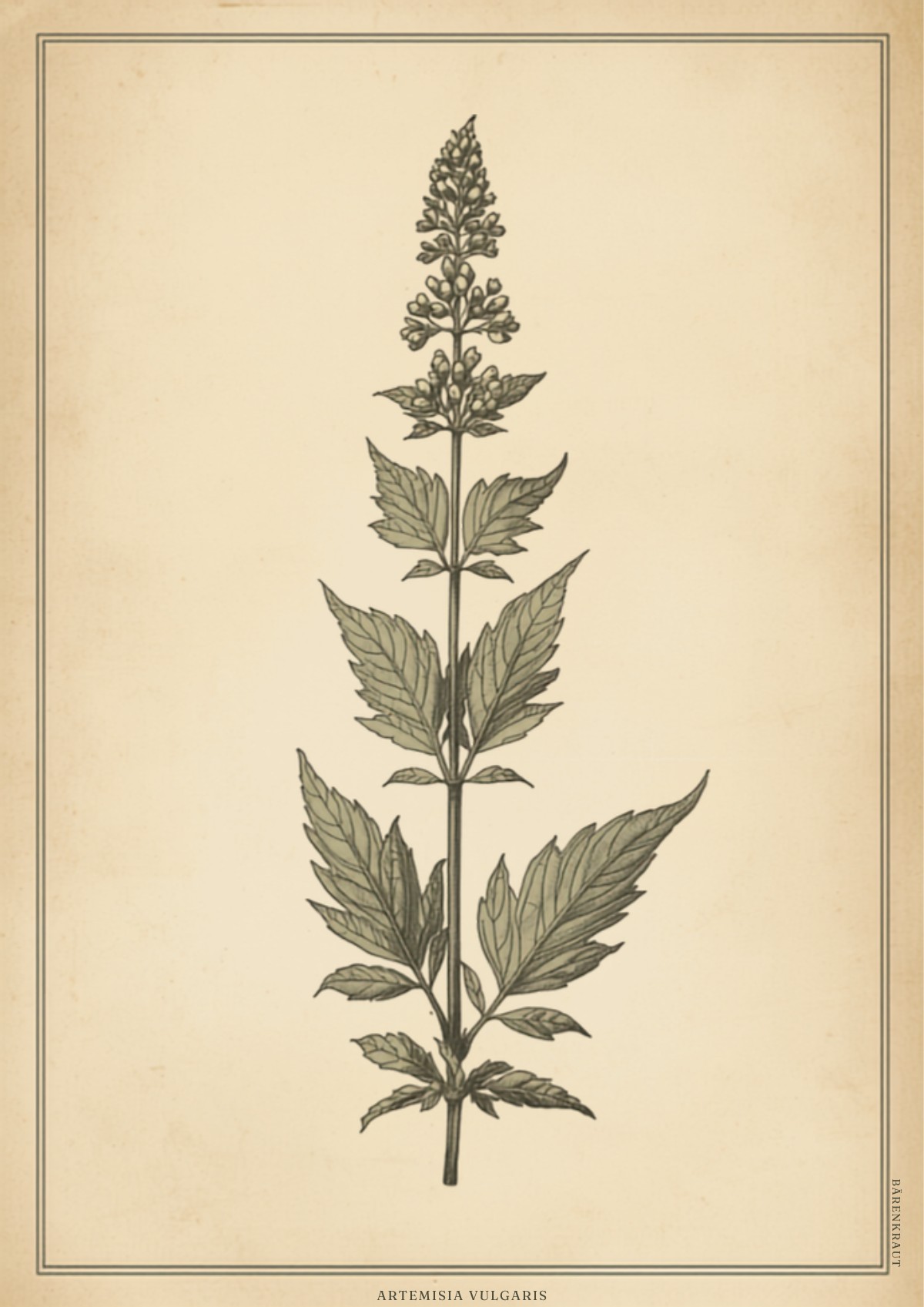
Mugwort (Artemisia vulgaris), the bitter herb Hildegard von Bingen praised to warm the stomach.
Mugwort belongs to the Artemisia genus, a sprawling family of aromatic, bitter plants that includes wormwood, tarragon, and sagebrush. The name is thought to derive from Artemis, the Greek goddess of the wild and of childbirth, a hint at how long this plant has accompanied human life. Roman soldiers were said to tuck mugwort into their sandals to ease tired feet on long marches; medieval brewers used it to flavor and preserve ale before hops became the standard, which is one plausible origin of the “mug” in its English name.
By the time Hildegard was writing in the Rhine valley, mugwort was already woven into the European pharmacopeia. It was a plant of thresholds and transitions — hung over doorways, carried for protection, and, more practically, brewed into bitter teas for the stomach. The herb’s reputation rested on something anyone could verify with their own tongue: it is genuinely, memorably bitter. In an age that read the body through the four humors, that bitterness was not a flaw to be masked but the very signature of its usefulness. Across the medieval monastic world, herb gardens were as much a part of the cloister as the chapel, and the knowledge of plants passed from one generation of religious to the next. Mugwort, hardy and abundant, would have been among the easiest of these allies to grow and to gather.
What Hildegard von Bingen Wrote About Mugwort
Hildegard recorded her observations on plants in Physica, her catalogue of the natural world’s healing properties, written sometime around the 1150s. Mugwort appears near the very beginning of her account of herbs, a placement that scholars have taken as a quiet mark of its importance to her. She classified it, in the language of her medicine, as a “warm” plant — and warmth, in Hildegard’s framework, was precisely what a cold, damp, underperforming digestion needed.
In Physica, Hildegard describes mugwort’s juice as “very useful” and recommends that the herb be cooked and eaten as a purée, in which form, she writes, it eases ailing intestines and warms a sick stomach. It is worth pausing on how modest and specific that claim is. She is not describing a cure-all. She is describing a food — a cooked green, folded into a meal — meant to coax a tired digestive system back into rhythm. This is characteristic of her whole approach: medicine and the dinner table were never far apart, and the most powerful interventions were often the most ordinary.
Hildegard’s instinct to treat mugwort as nourishment rather than as a drug is one reason her writing still reads sensibly today. She did not promise that the herb would banish disease. She suggested, in effect, that a warming bitter green could help the gut do its own work — a far cry from the language of the modern supplement aisle. For readers drawn to traditional European herbal medicine, this restraint is part of the appeal. Her counsel sits comfortably alongside her better-known enthusiasm for galangal as a warming digestive spice and her wider catalogue of bitter herbs.
The Science of Bitterness: Why Mugwort Was Trusted
Strip away the medieval cosmology and a coherent picture remains. Mugwort is what herbalists call a bitter tonic, and bitterness turns out to be more than a taste. The tongue carries dedicated bitter receptors, and these same receptor types have since been identified throughout the gut. When we taste something bitter, the body anticipates food: saliva flows, the stomach is prompted toward producing gastric juices, and the gallbladder is nudged to release bile. The traditional habit of taking a bitter herb shortly before eating maps neatly onto this reflex.
This is why mugwort, wormwood, gentian, and their bitter relations have been used for centuries to rouse a flagging appetite and ease the heavy, over-full feeling that can follow a rich meal. The mechanism Hildegard could not have named — she spoke of warmth and the drying of excess moisture — describes much the same phenomenon she observed: a bitter plant that seems to wake up a sleepy stomach. Mugwort’s characteristic compounds, including a family of bitter sesquiterpene lactones, are concentrated in the leaves and flowering tops and give the herb its pronounced taste. It is a quiet vindication of folk practice that the very bitterness early herbalists prized as a marker of potency turns out to correspond to the chemistry now thought to drive these digestive reflexes. Hildegard, who trusted what she could observe, was reading a real signal even if she described it in the vocabulary of her century.
Honesty requires a caveat the careful reader will already expect. Modern clinical research on mugwort specifically is thin; most of what we can say rests on long traditional use and on the better-studied physiology of bitter compounds in general rather than on large trials of this particular plant. Mugwort is traditionally used to support digestion and appetite, and that phrasing is deliberate. It is the honest distance between a centuries-old practice and a proven pharmaceutical — a distance Hildegard, an empiricist working from observation, might have respected.

Mugwort takes its place among the bitter botanicals of Hildegard’s digestive bitters tradition.
How to Bring Mugwort to the Modern Table
The simplest inheritance from Hildegard is also the most usable. A small amount of dried mugwort can be steeped as a tea and sipped before a meal, where its bitterness does the quiet work described above. Cooks in central Europe still use the herb much as the abbess suggested — a pinch added to roast goose, fatty pork, or bean dishes, where it both seasons and, by tradition, helps the body manage richer fare. A little goes a long way; mugwort is assertive, and the goal is a bitter edge, not a bitter meal.
For those who would rather not forage and dose by hand, the same family of warming bitters that Hildegard prized has been carried forward into prepared formulas. Eurbal’s Hildegard’s Bitters formula draws on this same tradition of bitter, digestion-supporting botanicals, offering a measured way to keep a bitter ritual before meals without maintaining a windowsill of dried herbs. If you are new to bitters altogether, it is worth understanding how Hildegard’s herbal digestive bitters work before reaching for any single plant.
A Word of Caution and Respect
Mugwort deserves the same respect as any potent traditional herb. It is closely related to ragweed, and people with allergies to that plant family may react to it. More importantly, mugwort has a long historical association with stimulating the uterus and was used in the past in the context of menstruation and childbirth — which is precisely why it should be avoided during pregnancy. As with any herb, anyone who is pregnant or nursing, taking medication, or managing a health condition should speak with a qualified healthcare provider before adding mugwort to their routine. Traditional wisdom and personal caution were never meant to be at odds.
What endures in Hildegard’s brief, practical notes on mugwort is an attitude as much as a remedy: a respect for ordinary plants, an interest in the body’s own intelligence, and a refusal to oversell. The unremarkable weed at the roadside carried, in her telling, a small and specific gift — the power to warm a cold stomach and steady an unsettled gut. Eight centuries later, that is still a reasonable thing to ask of a bitter herb, and a graceful place for the curious cook to begin.
To explore the wider world of warming bitters in this tradition, you can also read about wormwood, mugwort’s more famous bitter cousin.
Bring the Bitter Tradition to Your Own Table
If the history of mugwort and its bitter relatives has sparked your curiosity, the simplest place to begin is with a thoughtfully made bitters formula rooted in Hildegard’s botanicals. Explore Hildegard’s Bitters on Amazon →
These statements have not been evaluated by the Food and Drug Administration. This product is not intended to diagnose, treat, cure, or prevent any disease. This article is provided for educational and historical interest only and is not a substitute for professional medical advice. Consult a qualified healthcare provider before using any herb, particularly if you are pregnant, nursing, taking medication, or managing a health condition.