
The hardest part of intermittent fasting isn’t the fast itself. It’s the meal that ends it.
If you’ve practiced any form of time-restricted eating — whether 16:8, OMAD, 24-hour fasts, or longer protocols — you’ve probably experienced this: you make it through the fasting window without issue, then eat your first meal and feel worse than if you’d just eaten normally. Bloating. Heavy stomach. Sluggish digestion. Sometimes nausea.
This is called refeeding distress, and it’s not random. It has a specific physiological cause — and digestive bitters address it directly.
Why Breaking a Fast Can Cause Digestive Distress

Digestive bitters ease the transition into and out of fasting windows without breaking a fast
Your digestive system doesn’t sit idle during a fast. But it does downregulate.
After several hours without food, your stomach reduces hydrochloric acid secretion. Your pancreas dials back enzyme production. Your gallbladder produces less active bile. Your gut motility slows. These are energy-conservation adaptations — your body is efficient about not producing digestive machinery it doesn’t immediately need.
This is appropriate and normal. The problem comes when you end the fast without warning your digestive system first.
When you go from zero food intake directly to a meal — especially one with fat and protein — you’re asking your digestive system to perform at full capacity with a cold engine. The result is predictable: incompletely digested food, fermentation in the lower GI tract, gas production, and the bloated, heavy feeling that makes post-fast meals miserable.
The standard advice is to “break your fast gently” — start with something easy to digest before your main meal. This is correct, but it only addresses the symptom. Digestive bitters address the cause.
How Bitter Compounds Prime the Digestive System
The bitter taste response is what scientists call a “cephalic phase” digestive response — it happens in the head (cephalus), before food even reaches the stomach.
When bitter compounds from gentian root, artichoke leaf, or other bitter herbs contact TAS2R taste receptors in your mouth and throat, they trigger an immediate neurological cascade:
- Gastric acid secretion begins, acidifying the stomach in preparation for protein digestion
- Pancreatic enzyme production ramps up — lipase for fats, protease for proteins, amylase for carbohydrates
- Bile release from the gallbladder increases, ready to emulsify dietary fats
- Gut motility activates, preparing the peristaltic contractions that move food through the intestinal tract
All of this happens within minutes of bitter receptor activation — before you take your first bite of food.
This is exactly the preparation that gets bypassed during a fast. Taking digestive bitters 10–15 minutes before breaking your fast essentially runs a “warm-up sequence” for your digestive system — signaling it to fully re-engage before the meal arrives.
Bitters and Sugar Cravings in the Fasting Window
One of the most consistent reports from people who incorporate bitters into their fasting practice is reduced sugar cravings — both during the fasting window and during the eating window.
This isn’t a placebo effect. There’s a clear receptor-level mechanism at work.
Bitter and sweet taste signals compete for attention in your nervous system. When TAS2R receptors are strongly stimulated by bitter compounds, sweet craving signals are partially suppressed. Research on bitter receptor activation suggests that the effect can last 30–60 minutes after taking bitters.
For people doing intermittent fasting for metabolic health, fat loss, or blood sugar management, this is a meaningful benefit. The cravings that break fasts early, or lead to poor food choices in the eating window, are often sudden and intense — and a strong bitter stimulus at the onset of a craving can interrupt it within 5–10 minutes.
Traditional practitioners were aware of this effect long before the receptor science was understood. Hildegard of Bingen’s fasting protocols, documented in her 12th-century medical writings, specifically incorporated bitter herbs as a way to maintain discipline during extended fasts and to ease the transition back to eating.
Hildegard’s Fasting Protocol and the Role of Bitters
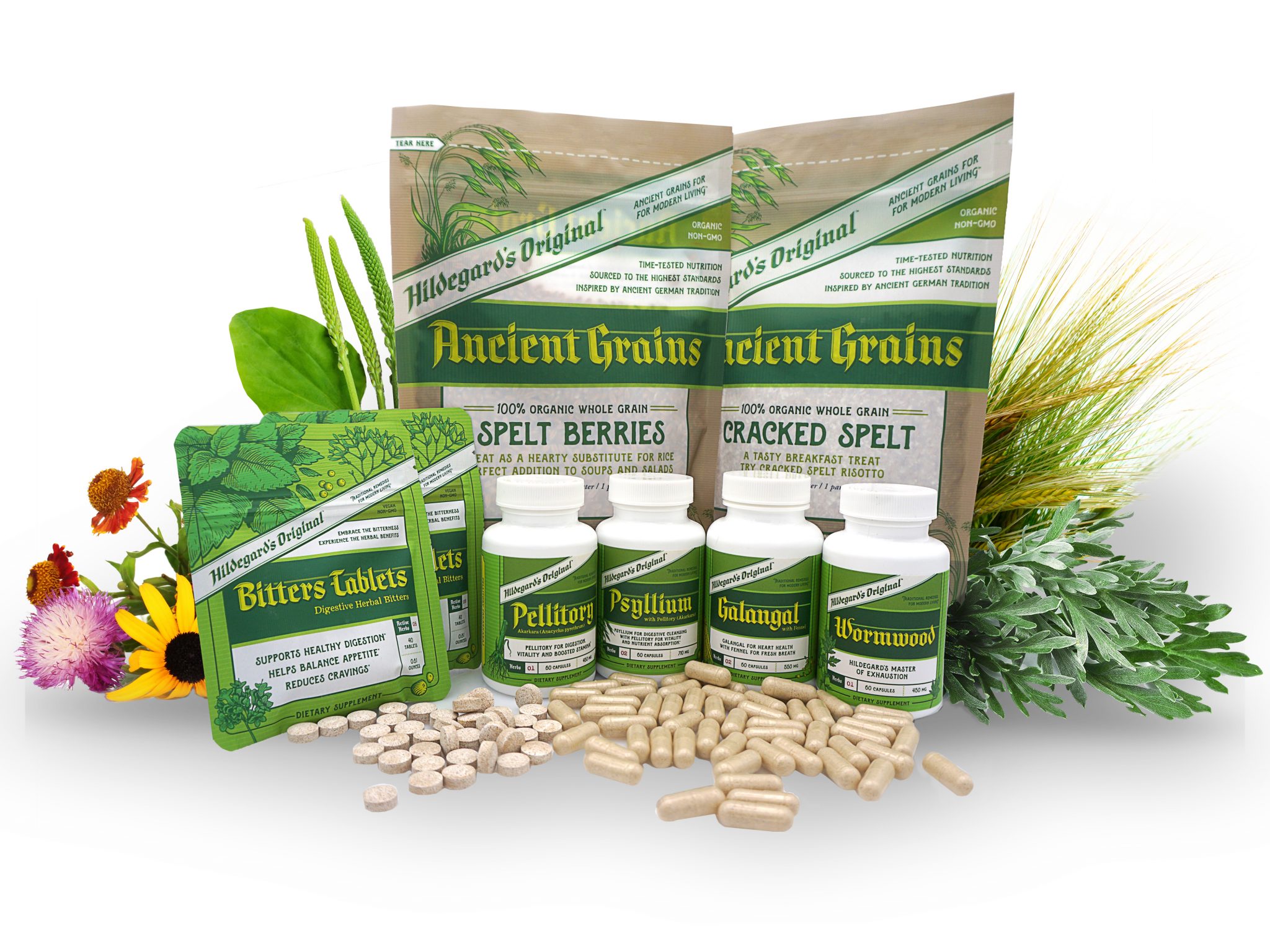
Hildegard’s Bitters Tablets support healthy digestion before, during, and after intermittent fasting
Hildegard of Bingen is considered the founder of Western herbal medicine, and her approach to fasting was sophisticated by any era’s standards. She prescribed regular fasting periods — often aligned with religious calendar days — as a practice for physical purification and mental clarity.
What distinguished Hildegard’s approach was the use of bitter herbs both during and around fasting periods:
- Before a fast: Bitters were used to fully clear the digestive system, ensuring complete processing of the final pre-fast meal
- During longer fasts: Small amounts of bitter herbal preparations supported what she called “cleansing of the blood and organs” — language that maps reasonably well onto what we now understand as liver and bile support
- Breaking a fast: Bitter herbs were taken before the first meal to prepare the digestive system for reactivation
This three-stage protocol — prepare, support, reactivate — is remarkably consistent with what modern physiology tells us about fasting and refeeding.
Recommended Protocol: Bitters and Intermittent Fasting
Before your eating window opens:
Take 1–2 bitters tablets on your tongue 10–15 minutes before your first meal. Dissolve completely — do not swallow whole. The bitter sensation tells you the mechanism is working.
If you experience mid-fast sugar cravings:
A single tablet dissolved on the tongue can interrupt a craving signal within 5–10 minutes. This will not break your fast — pure bitter herb compounds have negligible caloric content and do not trigger an insulin response.
Do bitters break a fast?
Properly formulated digestive bitters tablets — containing only concentrated bitter herb extracts — have essentially zero caloric impact and do not stimulate significant insulin secretion. They work through the bitter taste receptor pathway, not through caloric intake. For practical fasting purposes, they do not break a fast.
(Note: This applies to pure bitter herb formulations. Bitters preparations containing sugar, honey, or other caloric ingredients would be a different matter.)
After your eating window:
Some practitioners take bitters after their final meal of the eating window to ensure complete digestion before the fasting period resumes. This is particularly useful for people who eat larger or higher-fat meals at the end of their eating window.
Who Benefits Most from Combining Bitters with Fasting
- People who experience bloating or digestive discomfort when breaking fasts
- People who struggle with sugar cravings during fasting windows
- People doing longer fasts (20+ hours) who find digestive re-engagement difficult
- People practicing time-restricted eating for metabolic health or blood sugar management
- Anyone following a higher-fat eating protocol (carnivore, ketogenic) during their eating window — fat digestion is particularly bile-dependent, making gallbladder support especially relevant
What to Expect
First week: The bitter taste will be intense, especially if you’re fasting and your palate is more sensitive. This is normal. The bitterness is the mechanism.
Weeks 2–3: Most users report noticeably smoother digestion when breaking their fast — less bloating, faster gastric emptying, less post-meal heaviness. Sugar cravings during the fasting window tend to reduce.
Ongoing: The digestive benefits of bitters compound with consistent use. Regular bitter stimulation supports the long-term health and responsiveness of your digestive system — not just the single meal you’re preparing for.
Related Reading
- Hildegard’s Guide to Fasting and Health
- Digestive Bitters for Bloating
- How Digestive Bitters Work
- What Are Digestive Bitters?
- Shop Hildegard’s Bitters Tablets
Hildegard’s Original Digestive Bitters Tablets are available on Amazon. Gentian root, ginger, and artichoke leaf — concentrated bitter herb extracts in an alcohol-free, travel-friendly tablet. The traditional fasting support formula brought current.
These statements have not been evaluated by the Food and Drug Administration (FDA). This product is not intended to diagnose, treat, cure, or prevent any disease.