
There is a plant that grows in the thin grass at the edge of European woodland — a square-stemmed, purple-spiked member of the mint family that almost nobody plants on purpose anymore. For roughly fifteen centuries, it was the opposite of obscure. The wood betony benefits catalogued by Roman, Anglo-Saxon and medieval writers ran to dozens of entries, and when Hildegard von Bingen composed her Physica in the middle of the twelfth century, she gave betony one of the longest chapters in the whole work.
What she wrote about it is stranger, and far more interesting, than a list of symptoms. Hildegard was not primarily interested in betony as a remedy for an ailment. She was interested in it as a guardian of sleep — and, through sleep, of the mind and the soul. Her betony chapter is one of the clearest windows we have into the way she actually thought: that a plant is not a chemical delivery system but a participant in a living, divinely ordered world, and that healing the body and steadying the spirit are the same work approached from two directions.
A Plant Once Worth More Than the Coat on Your Back
Before we get to Hildegard, it helps to understand how seriously the pre-modern world took this herb. Pliny the Elder, writing in the first century, reported that betony was esteemed above almost any other plant, and passed along the folk conviction that simply keeping it in the house kept harm away. He credited its discovery to the Vettones of Iberia, which is where the old botanical name Vettonica comes from.
A late-antique treatise called De herba Vettonica liber — long attributed to Antonius Musa, the physician to Augustus, though scholars now place it in the fourth century — lists close to fifty separate applications for the plant, from pain after childbirth to snakebite to what the text calls simply “horrors.” By the time John Gerard compiled his Herball in 1597, betony had accumulated so many claims that the chapter reads like an inventory of everything that can go wrong with a person.
Two old sayings survive that tell you everything about its reputation. The Italians said: sell your coat and buy betony. The Spanish paid a person the compliment of having “as many virtues as betony.” In the Middle Ages, the herb had effectively achieved the rank of a panacea — and, notably, it was also the plant of choice for driving off what people then understood as demonic influence.
That last detail matters, because it is precisely the register in which Hildegard picks the plant up.
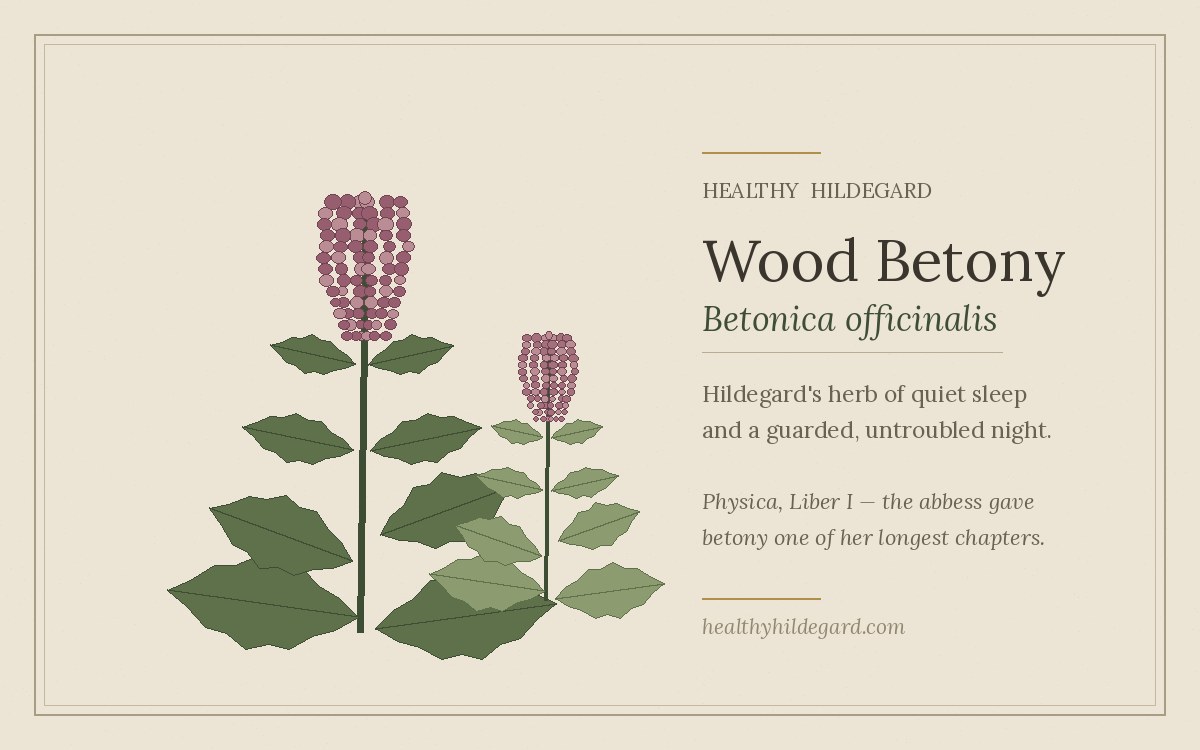
Wood betony (Betonica officinalis) received one of the longest chapters in Hildegard’s Physica.
Wood Betony in Hildegard’s Physica: Sleep, Reason and the Guarded Night
The research group on monastic medicine at Würzburg — the scholars behind the Welterbe Klostermedizin project, who work directly from the manuscript tradition — note something remarkable about Hildegard’s betony chapter: her indications for the plant depart almost entirely from the standard medieval ones. Everyone else was using betony for pain, much as we now reach for aspirin. Hildegard went somewhere else.
Applied externally, she held, betony strengthens reason and the power of the understanding — and it does so because it prepares good sleep. That causal chain is the whole argument in miniature. Clear thinking is downstream of proper rest. She also wrote that betony protects against bad dreams, adding the qualification that runs through all her medical writing: if God permits it. Elsewhere in the same chapter she describes an application for a person driven to distraction by love, and recommends the leaves or root where menstruation has become irregular.
It is worth being precise about what this is and is not. This is not a clinical protocol, and Hildegard never presents it as one. The Würzburg scholars describe it accurately as a blend of magical and religious thinking — a blend common in Hildegard, though not typical of monastic medicine as a whole. Reading her honestly means neither sanding off the twelfth century nor pretending she was running trials.
But the framework underneath is coherent, and it is the part worth carrying forward. Hildegard understood the sleeping person as vulnerable in a specific way. In her Causae et Curae, sleep is the state in which the body rests while the soul stays awake — a condition she compared to the turning of the moon and the succession of the seasons, part of the same cosmic rhythm rather than an interruption of it. A herb laid beside a sleeper was not a sedative in our sense. It was a form of keeping watch.
Viriditas and the Night: Why Hildegard Treated Rest as Spiritual Work
The idea that holds all of this together is viriditas, Hildegard’s greening power — the moist, verdant life-force she saw running through plants, animals, human beings and the created order alike. Viriditas is not a metaphor for chlorophyll. It is her word for vitality as a divine gift: what makes a meadow green in May is the same energy that makes a person flourish, and its opposite, ariditas, is the drying-out that shows up as illness, exhaustion and spiritual flatness.
Seen through that lens, sleep stops being downtime. It is when viriditas does its restoring work without interference from the will — which is why Hildegard took a disturbed night as seriously as a disturbed stomach, and why she thought a plant could have a role in guarding it. Her whole system assumes that the body, the mind and the soul are not three departments but one household. You cannot quietly wreck your sleep and expect your judgment, your temper and your prayer to be unaffected.
She built this conviction into the structure of the day. The Benedictine hours she lived by divided time into alternating stretches of work, reading, eating and rest, and she considered that rhythm itself medicinal — a point we explore in more detail in Hildegard’s monastic daily routine. Her account of the four temperaments extends the same logic to personality: each constitution sleeps, digests and reacts differently, and what balances one person may unbalance another. The governing virtue she names for all of it is discretio — discernment, moderation, the refusal of extremes.

For Hildegard, rest was not idleness. It was viriditas doing its quiet work.
What Modern Research Has Found in Wood Betony
Betony has largely fallen out of contemporary herbal practice, which makes the recent phytochemical work on it something of a curiosity. Analyses in Germany and the United States have found that a number of the medieval indications are, on the basis of the plant’s constituents, not as far-fetched as they might sound.
The plant is notably rich in betaine, tannins and caffeic acid derivatives. Phytochemists working on the aerial parts of Stachys officinalis have isolated a family of phenylethanoid glycosides — named betonyosides A through F — alongside better-known compounds including acteoside (verbascoside), forsythoside B and campneoside II. In antioxidant assays, chlorogenic acid and these phenylethanoid glycosides are the principal radical-scavenging constituents, with methanol extracts registering roughly 714 µM trolox equivalents per gram of dry extract in DPPH testing. Related Stachys species and their iridoid constituents have been examined for anti-inflammatory activity.
None of this validates a twelfth-century claim about dreams, and it should not be read as though it did. What it does establish is that betony is a chemically substantial plant rather than a folkloric placeholder — which is the same pattern we keep meeting across Hildegard von Bingen’s herbs, where the mechanism she proposed is almost always wrong and the plant she chose is almost always interesting.
How Wood Betony Is Traditionally Used Today
Where betony survives in modern European herbal practice, it is treated as a gentle bitter and a nervine — traditionally used as an infusion of the dried aerial parts, taken in the evening, and historically associated with settling the mind before sleep. It is mildly astringent, which is why older texts pair it with sore throats and mouth rinses. In blends it sits comfortably alongside the other calming herbs of the monastic garden; readers who have followed our writing on valerian root for anxiety and sleep will recognise the same territory, approached from a different angle.
It also belongs to the bitter family in a broader sense. Like Hildegard’s hyssop leaf, betony was valued for a quality — a clean, slightly drying bitterness — rather than for a single targeted action. Hildegard’s pharmacy is full of plants chosen this way. She was not treating a symptom; she was adjusting a balance.
A few practical cautions, offered plainly. Betony is not a well-studied herb in the modern clinical sense, and the available human evidence is thin. It is traditionally avoided in pregnancy. Anyone taking prescribed medication, particularly for sleep, mood or blood pressure, should speak with a qualified practitioner before adding it. And betony should not be confused with Pedicularis species, sometimes sold in North America under the same common name — a different plant entirely.
The Thread Back to the Table
What stays with us about the betony chapter is not the remedy. It is the assumption behind it: that the aim of a herb is not to suppress a symptom but to support a person’s whole flourishing — body, mind and soul together, in a world Hildegard understood as alive and ordered rather than inert.
That assumption is why she wrote so extensively about bitters. Bitter plants, in her framework, do something subtler than settle a stomach: they bring attention back to the body at the moment of eating, and they belong to the same greening order as everything else in the garden. If you would like to read how her formulations were composed, The Hildegard Formula at Eurbal walks through the botanicals and the reasoning behind them, and their introduction to Hildegard von Bingen gives the shorter version of her life and work.
And if you would like to keep a traditional bitters on the table — the sort of small, unhurried ritual Hildegard would have recognised — Hildegard’s Bitters is available on Amazon. It is a modest thing. Most of what she recommended was.
Disclaimer: These statements have not been evaluated by the Food and Drug Administration. This product is not intended to diagnose, treat, cure, or prevent any disease. The historical and traditional uses described in this article are presented for educational and cultural interest and are not medical advice. Please consult a qualified healthcare provider before using any herb, particularly if you are pregnant, nursing, or taking medication.