
Something in us registers the change before the calendar does. The light arrives at a lower angle. Evening turns up without warning. Appetite drifts toward food that has been cooked a long while. For most of human history this was not sentiment but information — the year telling the body what to do next. Seasonal living was not a wellness practice to be adopted. It was the only way anyone lived.
Hildegard von Bingen, the twelfth-century Benedictine abbess of the Rupertsberg, took that ordinary experience and gave it a cosmology. In her medical writing and in her visionary theology alike, the turning year is not the backdrop to human health but a participant in it. To live well, as she understood it, was to move at the measure of a world that was itself in motion — and autumn, when the measure changes most sharply, is when the practice asks the most of us.
The Turning Year as One Living Order
Hildegard’s final visionary work, the Liber Divinorum Operum (Book of Divine Works), completed around 1173, opens onto a set of images that have fascinated readers ever since. In them the whole sphere of the world appears with its circles, its celestial bodies and its winds, arranged as a wheel; a human figure stands at the center of it, limbs outstretched, joined to the whole. Later visions in the same book turn on a wheel of the seasons set alongside the ages of a human life.
The theological claim inside that imagery is straightforward, and it is the reason her work still reads as modern. Hildegard conceived the cosmos as macrocosm and the human being as its microcosm — physical, spiritual and moral. The winds, the spheres and the seasons are not external forces acting on a sealed body. They are the same order the body is made of, running at a larger scale. Her word for the vitality moving through that whole order was viriditas, the divine greening: the freshness that rises in a plant, in a landscape, and in a person, and that withdraws again in its season without being lost.
Which is why autumn, in her framework, is not decline. It is one movement of a single living order — the point at which greenness turns inward rather than outward.
Seasonal living, for Hildegard, meant moving with the year rather than against it.
Autumn and the Humors: Why the Body Notices the Season
Hildegard’s medical treatise Causae et Curae (Causes and Cures) is organized in five books, and the first of them begins not with symptoms but with creation: the structure of the world, the elements, and the humors. That ordering is deliberate. Diagnosis, for her, begins with where a person stands in a cosmos.
The clinical framework she inherited was humoral — the doctrine of the four humors that reached the twelfth century through the Galenic tradition, which Hildegard integrated with the four elements of the natural world. Health, in that model, is proportion; illness is proportion lost. Her account of the bodily humors and balance assumed that the mix shifts with conditions — with weather, with season, with the hours of sleep a person keeps. She went so far as to compare human sleeping and waking to lunar cycles and to the changing of the seasons, a comparison that historians of medicine still find striking.
Read that way, the familiar autumn complaints — heavier sleep, slower digestion, a pull toward denser food, a certain inwardness — are not malfunctions. They are what a body does when the order it belongs to cools and dries. Her practical advice followed the same logic she applied to temperament: what suits one constitution in one season may unbalance another. Her map of the four temperaments is best understood as a reminder that the same autumn does not ask the same thing of every person.
In Physica, her catalogue of the natural world, plants and foods carry qualities — warm or cold, dry or moist — that are meant to be matched against a person and a moment. As the weather turns, the matching moves toward the warm and the cooked: soups, stews, roots, grains, and generously spiced dishes rather than raw and cooling ones. Our guide to cold weather foods works through that principle in the kitchen.
Discretio: The Virtue That Makes Seasonal Living Possible
None of this becomes a practice without the idea Hildegard inherited from the Benedictine tradition and made her own: discretio, usually rendered as discernment or measure. Benedict had called discretion the mother of virtues, and Hildegard applied it without much sentimentality to the body. Too much injures. Too little injures. The work of a healthy life is finding the middle, and the middle moves.
That last clause is the part modern wellness culture tends to drop. A regimen that suits July is not automatically wise in October, and the instinct to answer a change of season with a program of correction — a cleanse, a challenge, a reset — is closer to the excess Hildegard warned against than to the moderation she prescribed. Balancing discretio with discretion means recalibrating rather than overhauling: slightly earlier nights, slightly warmer food, slightly more silence.
What Modern Research Says About the Body’s Year
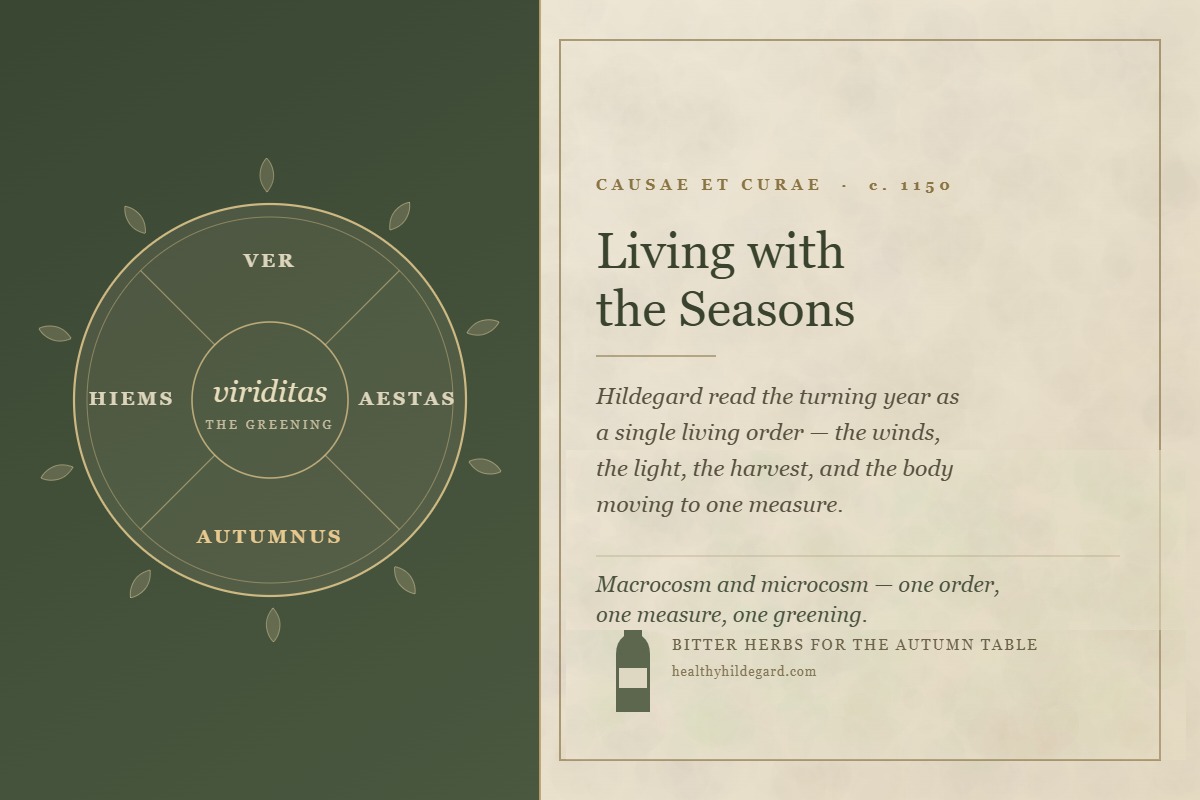
The turning year as one order: macrocosm and microcosm moving to a single measure.
Hildegard had no instruments, and she would not have framed any of this as a hypothesis. Still, contemporary chronobiology has arrived at a picture she would have recognized: the human body does not run at one setting all year.
Studies using wearable light sensors have found that the amount and duration of time people spend in bright light is itself seasonally rhythmic — higher around the summer solstice, lower around the winter one — and that certain clock-gene expression patterns track those seasonal light and activity changes. The more sobering finding concerns what modern life does to that rhythm. Researchers describing the contemporary light environment note that by living indoors under artificial lighting we are flattening the natural seasonal differences in light exposure, and that circadian disruption is associated with inflammatory signaling and with the course of chronic disease. One prospective analysis of personal light exposure in more than 88,000 adults reported that brighter nights and darker days were associated with higher mortality risk.
The point is not that a medieval abbess anticipated chronobiology. It is that she was working from a premise the data keeps supporting: a body kept at one artificial setting, indifferent to the year, is a body out of proportion. She simply called it by another name.
A Hildegard-Shaped Autumn Practice
What follows is not a protocol. It is the shape of the thing, drawn from her own priorities.
- Take the morning light while it lasts. Fifteen minutes outdoors before the day closes in does more for the sense of the season than any supplement. As the afternoons shorten, front-load the light.
- Keep the hours. Hildegard lived inside a timetable of fixed prayer, work, meals and sleep. The monastic daily routine is less austere than it sounds, and its central insight — that regularity is itself restorative — costs nothing to borrow.
- Eat what is ripe now, and eat it warm. Squash, roots, apples, pears, spelt, brassicas, and long-cooked things. The autumn table is an easy place to practice measure.
- Treat rest as a good, not a concession. For Hildegard, sleep restored the soul as much as the body; the spiritual meaning of rest was not downtime between useful hours.
- Make room for silence and for attention. Her cosmos rewarded looking at it. The healing power of silence and a habit of awe and wonder are, in her framework, health practices rather than moods.
- Let bitter herbs precede the heavier table. Gentian, wormwood, galangal and their relatives run all through Hildegard’s writing, and bitter plants have been traditionally used before meals for generations in the German herbal tradition that grew out of her work.
The Greening That Turns Inward
There is a reason Hildegard’s seasonal thinking still lands with people who are wary of wellness advice. It asks for no purchase and promises no transformation. It proposes something quieter: that the year is an order you are already inside, that the body registers its turning whether or not you consent, and that attention paid to the turning is itself a kind of health. Autumn is not the season for forcing anything. It is the season for matching a measure.
Bitter Herbs for the Autumn Table
If Hildegard’s botanicals interest you as more than history, the Hildegard Formula gathers the bitter herbs most associated with her writing — and our background on Hildegard von Bingen’s herbal tradition explains how that formula was assembled. Hildegard’s Original Bitters Tablets are available on Amazon for anyone who would like to keep a measure of bitter herbs on the table this season. No urgency — the year will still be turning next week.
These statements have not been evaluated by the Food and Drug Administration. This product is not intended to diagnose, treat, cure or prevent any disease. This article is offered for historical and educational interest and is not medical advice; please consult a qualified healthcare provider about your own circumstances, particularly if you are pregnant, nursing or taking medication.